2025 ANNUAL REPORT
EXPLORE. DISCOVER. PROTECT.
Exploring and Protecting the Ocean’s Twilight Zone
A MESSAGE FROM MARE’S CHAIR
AND NEW EXECUTIVE DIRECTOR
In 2025, despite pervasive cutbacks in government funding for environmental research, MARE persisted in expanding our repository of seafloor imagery and trend data, so our work can continue to provide decision-makers with trusted and actionable insights to manage and protect our ocean’s critical resources. When not at sea, our talented team advanced MARE’s deep-sea robotic capabilities and AI video processing to increase the scope, efficiency, and flexibility of our exploration and analysis. As part of our leadership transition, we have been working to deepen MARE’s integration into the broader ocean research ecosystem, including new partnerships with Woods Hole, the Global/Deep Ocean Observing System, and SeaKeepers (just to name a few), to launch a new phase of growth and global impact. Looking ahead to 2026, we are inspired to continue our valuable long-term ecosystem monitoring work, and also to bring our proven technologies and approaches for intelligent ocean resource management to new seas.
Thank you so much for supporting our mission to explore and protect our ocean’s most vital hotspots!
LARISSA POMMERAUD
Executive Director and Board Chair
LOOKING BACK:
2025 PROJECT SUMMARY
- Our engineering team designed an innovative and cost-effective remotely operated vehicle to monitor and address entanglements on floating offshore wind cables for the California Energy Commission.
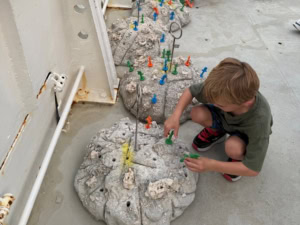
- Our marine biology team designed and tested new artificial reef structures to improve coral out-planting progress in the Gulf for the National Oceanic and Atmospheric Administration (NOAA).
- Our offshore team conducted Marine Protected Area ecosystem monitoring surveys across the northern third of California’s coastline’s for the Department of Fish & Wildlife, to be followed by the remainder of the CA coastline in 2026.
- Our education team taught hands-on deep-sea science and robotics workshops for more than 2,160 students at underserved Bay Area schools to inspire the next generation.
OUTCOMES FROM MARE-COLLECTED DATA AND PARTNERSHIPS
There can be months or even years between the time MARE collects new seafloor data and when the insights get published or make their way into policy changes. While we work to accelerate the impact of our research and exploration, we also celebrate the successes whenever they happen. That’s the long-term power of good data!
Quantifying Deeper Coral Reef Vulnerability to Marine Heatwaves
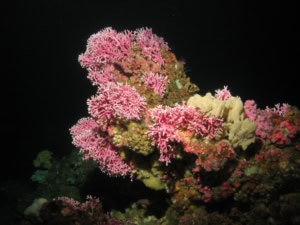
MARE’s long-term dataset was central to a landmark 2025 study by Rachel Wong titled “Decadal changes in California’s temperate mesophotic reef invertebrate community through the 2014-2016 Northeast Pacific marine heatwave”. Drawing on more than 15 years of deep reef data collected by MARE’s ROV team, the study shows how invertebrate communities, including sponges, corals, and tunicates, responded to recent marine heatwaves. The study confirms that deeper ecosystems are also vulnerable to climate impacts and highlights the value of sustained deep-sea monitoring across California’s Marine Protected Areas.
Quillback Rockfish
Recovery
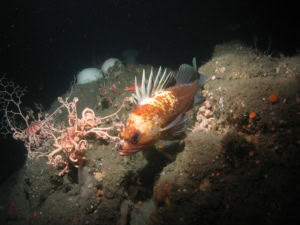
Quillback Rockfish (Sebastes maliger) were declared federally overfished in 2023, but a recent stock assessment based on data collected by MARE and the California Collaborative Fisheries Research Program (CCFRP) indicated that the population of quillback rockfish was robust enough to reduce restrictions on quillback rockfish take a win for the fishing community and a testament to the value of MARE’s actionable data for sustainable ocean resource management.
Assessing the Effectiveness of California’s
Marine Protected Area Network
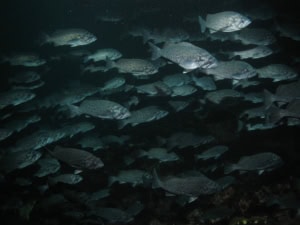
In 2022, the first-ever review of MPA effectiveness and management was conducted a decade after the completion of the statewide network in 2012. This historic effort used MARE’s long-term ROV dataset to build the first tangible, statistical insight into the improvements to the State’s mid-depth rocky reefs since the implementation of the MPA network. Powerful statistical analysis on MARE’s enormous dataset show promising trends of regional recovery and increased density of study species, supporting the State in continuing and potentially expanding MPA scope and enforcement to maintain the beauty and resilience of our west coast.
Coral Sampling for Successful Spawning
in Captivity
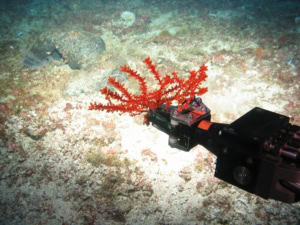
As part of the ongoing Deepwater
Horizon oil spill restoration efforts in the
Gulf, MARE’s ROV Beagle was used to
collect coral samples to propagate in the
lab for future outplanting. As a result, for
the first time ever, scientists from the
National Oceanic and Atmospheric
Administration (NOAA) were able to
successfully spawn species of interest in
captivity. This unprecedented event is a
significant step toward understanding
the biology and reproductive cycle of this
deeper, mesophotic coral, opening up
potential for more captive breeding
programs to support broader coral
restoration efforts.
Artificial Coral Habitat Design and
Deployment for Restorative Outplanting
In 2022, the first-ever review of MPA effectiveness and management was conducted a decade after the completion of the statewide network in 2012. This historic effort used MARE’s long-term ROV dataset to build the first tangible, statistical insight into the improvements to the State’s mid-depth rocky reefs since the implementation of the MPA network. Powerful statistical analysis on MARE’s enormous dataset show promising trends of regional recovery and increased density of study species, supporting the State in continuing and potentially expanding MPA scope and enforcement to maintain the beauty and resilience of our west coast.
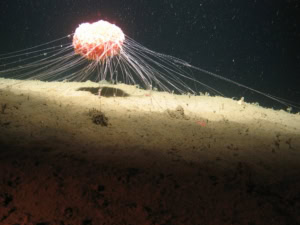
Highlighting Hidden
Habitats
As part of the ongoing Deepwater
Horizon oil spill restoration efforts in the
Gulf, MARE’s ROV Beagle was used to
collect coral samples to propagate in the
lab for future outplanting. As a result, for
the first time ever, scientists from the
National Oceanic and Atmospheric
Administration (NOAA) were able to
successfully spawn species of interest in
captivity. This unprecedented event is a
significant step toward understanding
the biology and reproductive cycle of this
deeper, mesophotic coral, opening up
potential for more captive breeding
programs to support broader coral
restoration efforts.
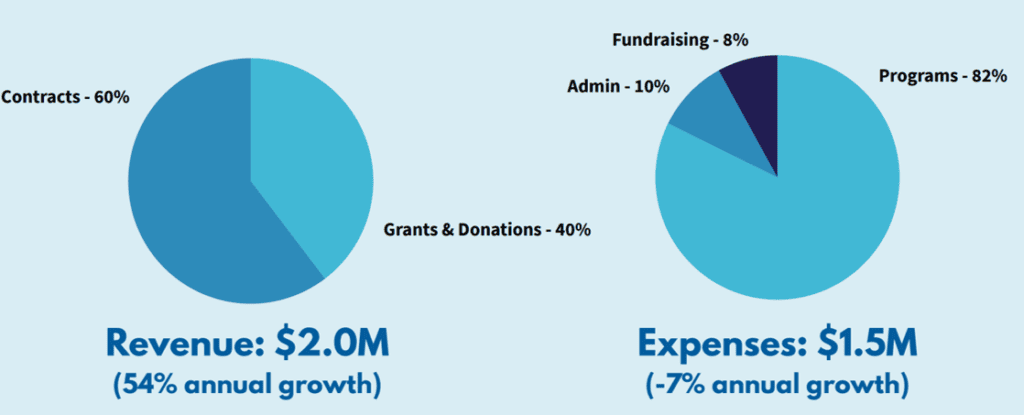
2025 FINANCIAL SUMMARY
OUR PASSIONATE SUPPORTERS
Over $200,000
Paul M. Angell Foundation
Peter J. Davis Family Foundation
Schmidt Family Foundation
$50,000-$199,999
Anonymous
Robert & Lisa Margolis Family Foundation
Dean & Ann Witter Fund for Charitable Giving
$10,000-$49,999
Danish Explorers Fund
Jon Graham & Elizabeth Ulmer
$500 -$9,999
Glenn Bucksbaum
Adeline Cheam
Ron Clausen
William Davidge & Peggy Evans
Kerry Davidson & Dan Fitzgerald
Patrick Donovan
Claudia Duncan
Ferguson Family Charitable Fund
Michael Gallagher & Ruth Shapiro
Jonathan & Giulianna Glassman
Mark Gordon
Yvonne Higgs McHugh & Anthony Brake
Thomas Hourigan
Gabriella Levine
Mats Nilsson
Gloria Oakes
Erin O’Toole
Larissa Pommeraud
Vilas Rao
Dirk Rosen
Glenn & Liliko Sakima
Michael Joseph Shearn II Charitable Giving Fund
Jennifer Steinmann
Peter & Karen Weber
OUR DEDICATED TEAM
Board of Trustees
Larissa Pommeraud – Chair and Executive Director
Gabriella Levine, Ph.D – Vice Chair and R&D Committee Chair
Patrick Donovan – Treasurer and Finance Committee Chair
Vilas Rao – Secretary and Income Committee Chair
Jon Glassman – Governance Committee Chair
Tom Hourigan, Ph.D. – Science Committee Chair
Adeline Cheam
Mark Gordon
Mats Nilsson
Erin O’Toole
MARE Team
Johnathan Centoni – Biological Video Processing
Kelly Ciccolo – Finance and HR
Madeleine Frost – Biological Video Processing
Greta Goshorn – Data Management
Nina Hipkins – Education and Outreach
Andy Lauermann – Science and Operations
Paul Lauermann – Georeferencing and Operations
Abby Nickels – Partnerships and Communications
Kyle Palmer – Engineering
Samuel Parker – Biological Video Processing and ROV Piloting
Neal Shipman – Engineering
Justin Smith – New Project Development
Jordan Stovall – Engineering and ROV Piloting
Isaac Travers – AI and Software Engineering